PUBLIC DOMAIN. The author has disclosed the algorithm and many of its properties on the web begining in late 2010 and it is his view that this constitutes "public disclosure". He repeated this position to the audience at ISAMA 11.
John is not on Facebook, does not tweet, has no cell phone, and doesn't use You Tube. THIS SITE is his internet presence. He does receive Email (see bottom of this page), answers his telephone, and opens snail mail.
For Powerpoint "movies" of the algorithm for different shapes click here. This is one of the best ways to really see what is going on.
The first published account of the algorithm is in the proceedings of the ISAMA 11 Conference (Chicago, June 2011). To view or download a Word version click here About 3 Mbytes.
A paper has been published in the refereed journal Computer Graphics Forum. click here
A paper has been presented at Bridges 2014 click here
A paper has been presented at JMM 2015 click here
Connection with Sierpinski click here
Connection with Apollonian circles click here
A Mathematical Introduction (new 7/28/15)
Cye Waldman click here
The gasket is as interesting as the shapes themselves, and study of it helps to explain why the algorithm works. For a study of the gasket and its average width click here
An interesting account of the algorithm with some examples having quite nice graphics can be found on Paul Bourke's fractal web site. click here
An example can be more useful than a bunch of verbiage. To view C code click C code.
Current status of studies by John and others click here
A million circle example click here
Does the statistical geometry algorithm work in 3 dimensions? click here
The statistics of trials and placements are studied in a report. click here
Non-uniform probability. click here
Grouped shapes -- a different form of the algorithm. click here
Link to an early (2011) assessment of the algorithm by 'Dr Goulu' (in French) click here
This takes you directly to John's original writeup on this site click here
Many of my fractal images have been made up as mug designs on Zazzle. You can see all of John's mug designs on the Zazzle site by clicking here. mugs
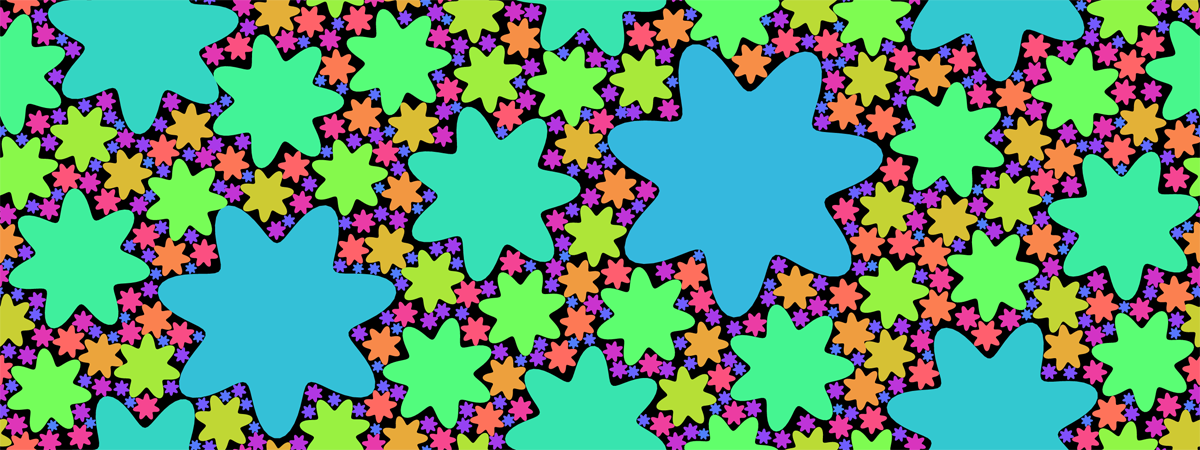
The image at the top of the page shows fractalized 7-tooth "gears". Log-periodic color.
The author is inclined to wonder if what is described here is not merely an "algorithm", but perhaps a "property of space itself".
I am happy to hear from people interested in this topic and can help if you want to get started on your own images. I am at johnart(atsign)frontiernet[dot]net.